
In the world of advanced English, there is a significant difference between being “fluent” and being “precise.” When discussing science, medicine, or complex data, precision is everything. If you speak with 100% certainty about a study that is still evolving, you might actually sound less professional.
This is where Hedging comes in. Hedging is the use of cautious language to distance yourself from a claim, ensuring you don’t overstate the facts. For advanced learners, mastering these nuances is the key to sounding like a sophisticated, credible communicator.
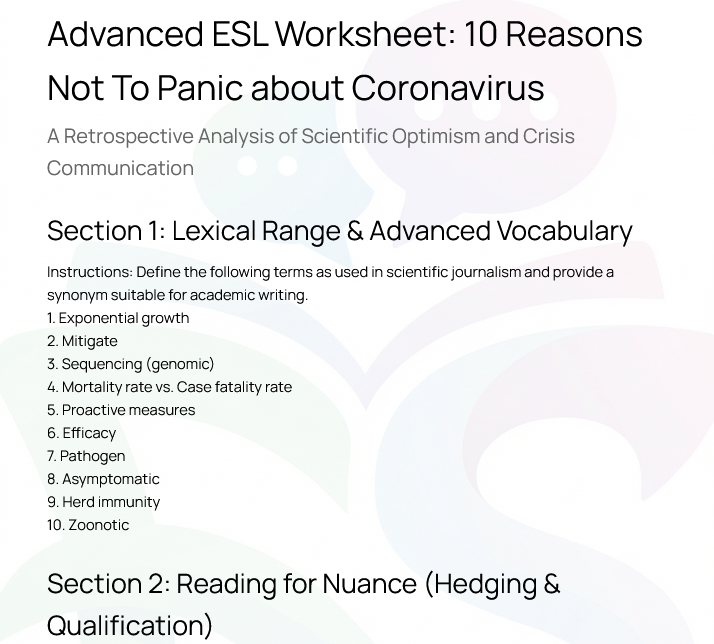
Let’s look at how to use these tools effectively, using “10 Reasons Not To Panic” report as our guide.
https://inews.co.uk/opinion/coronavirus-symtoms-cases-panic-vaccine-antivirals-recovery-406321
Why Hedging Matters
Scientific reporting isn’t about being “right” or “wrong”; it’s about the strength of the evidence. When we look at a report like 10 Reasons Not To Panic, the goal is to provide a balanced perspective on a stressful topic. If the author says, “This cure works for everyone,” they lose credibility the moment one person isn’t cured.
Instead, a scientist or a high-level journalist uses “hedges” to protect their reputation and accurately reflect the data.
Three Power Words for Your Vocabulary
To discuss data with precision, you need more than just “maybe” or “perhaps.” Here are three advanced terms to elevate your reporting:
1. Suggests
This is the workhorse of scientific English. Use it when the evidence points in a specific direction but isn’t yet a proven law.
- The Basic Way: “The data shows that the virus is weakening.”
- The Advanced Way: “The latest data suggests a downward trend in the virus’s potency.”
- Why it works: It allows for the possibility that future data might change the conclusion.
2. Apparently
Use this when you are describing something based on how it appears or what has been reported, but you haven’t personally verified it.
- Example from ’10 Reasons Not To Panic’: “Apparently, the initial projections were based on a worst-case scenario that did not materialize.”
- Why it works: It signals that you are relaying information based on current observations without claiming it is the absolute, hidden truth.
3. Purportedly
This is a high-level word used for claims made by others—often claims that haven’t been fully proven yet. It adds a healthy layer of professional skepticism.
- Example: “The new vaccine is purportedly effective against all variants, though we are waiting for the peer-reviewed results.”
- Why it works: It tells your audience, “Someone else is claiming this; I am simply reporting their claim.”
Practical Applications: Before and After
See how the tone changes when we apply hedging to scientific statements:
- Too Bold: “The climate crisis is over because of this new technology.” (This sounds like an amateur or a “clickbait” headline.)
- Scientifically Precise: “This new technology purportedly offers a significant reduction in carbon emissions, which suggests a more optimistic outlook for the climate.”
- Too Bold: “The medication has no side effects.”
- Scientifically Precise: “Apparently, no major side effects were recorded during the initial phase of the trial.”
Common Mistakes to Avoid
1. The Certainty Trap Advanced learners often feel that using “will” or “is” makes them sound more confident. In scientific reporting, the opposite is true. Using words like indicates, appears to, or likely shows you understand the complexity of the subject.
2. Over-Hedging Don’t use too many hedges in one sentence, or you will sound like you don’t know anything!
- Avoid: “It might be possibly true that the data purportedly suggests…” (Too weak!)
- Aim for: “The data suggests a possible correlation.” (Balanced.)
Final Encouragement
Transitioning from “general English” to “Scientific English” is a journey toward nuance. By using words like suggests, apparently, and purportedly, you are showing academic and professional maturity.
The next time you read a report like 10 Reasons Not To Panic, pay close attention to how the experts “soften” their claims. Try incorporating one of these words into your next discussion about data. You’ll find that people listen more closely when you speak with the precision of a scientist!


Leave a Reply