
Most learners think the Present Simple is just for “boring” facts—things like “The sun rises in the east” or “Water freezes at 0 degrees Celsius”. While that is true, the Present Simple is actually a powerful tool that can make your English sound more natural, energetic, and professional.
At the Intermediate level, it is time to move beyond basic facts and learn how to use this tense for your daily routines and for telling gripping stories.
Beyond Facts: Habits and Routines
The most common way native speakers use the Present Simple is to talk about things that happen regularly. We use it for our habits, schedules, and routines.
To make these sentences more precise, we often use Frequency Adverbs to show how often the action occurs:
- Always (100%): She always wakes up before 7 AM.
- Usually (75%): My brother usually calls me on weekends.
- Sometimes (50%): They sometimes go to the gym after work.
- Rarely (25%): We rarely have pizza for dinner, maybe once a month.
- Never (0%): I never forget my umbrella when it rains.
The Routine Checklist
When talking about your life, use the Present Simple for:
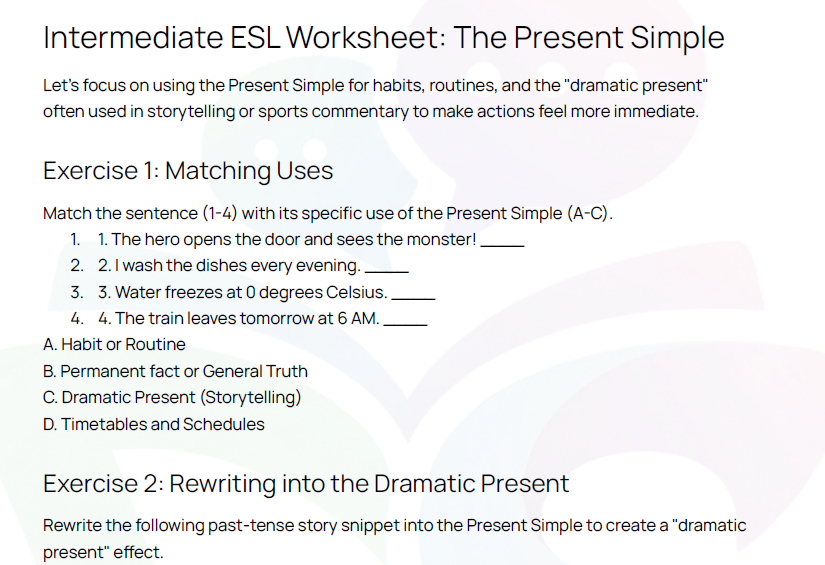
- Things you do every day: “I wash the dishes every evening”.
- Fixed schedules: “The train leaves tomorrow at 6 AM”.
- General preferences: “I love my dog Homer”.
The “Dramatic Present”: Bringing Stories to Life
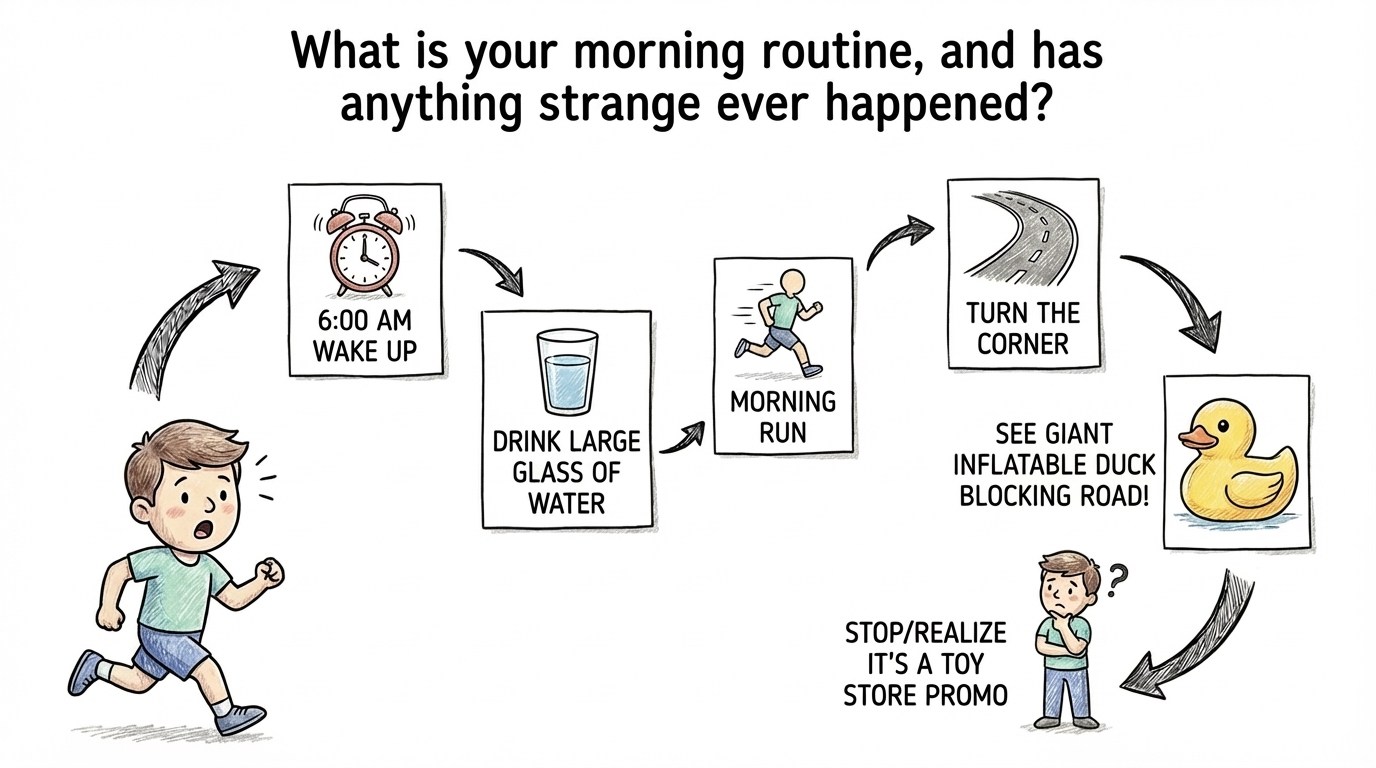
Have you ever noticed how sports commentators or storytellers speak? They often use the Present Simple even when talking about things happening right now or in a story. This is called the Dramatic or Narrative Present.
By using the Present Simple instead of the Past Tense, you make the action feel more immediate and exciting for the listener.
| Past Tense (Standard) | Narrative Present (Dramatic) | Why use it? |
|---|---|---|
| The detective walked into the room. | The detective walks into the room. | Makes the reader feel like they are there. |
| He looked at the window. | He looks at the window. | Creates a sense of urgency. |
| Suddenly, the phone rang. | Suddenly, the phone rings. | Great for “cliffhanger” moments. |
In sports commentary, this is essential: “Johnson takes the lead. He sprints toward the finish line!”.
Common Pitfalls to Avoid
Even at the Intermediate level, it is easy to slip up when things get fast. Keep an eye on these two common mistakes:
1. The Missing “-s”
When speaking quickly, many learners forget to add the -s or -es to the third-person singular (He, She, It).
- Wrong: “He look back.”
- Correct: “He looks back”.
- Wrong: “She cross the line.”
- Correct: “She crosses the line”.
2. Stative vs. Action Verbs
Remember that some verbs describe a “state of being” rather than a physical action. These Stative Verbs should almost always stay in the Simple form, even if you are talking about right now.
- Wrong: “I am needing to find my keys!”
- Correct: “I need to find my keys”.
- Wrong: “She is looking great today.”
- Correct: “She looks great” (describing appearance).
Note: Some verbs like “think” or “have” can be both, depending on the context!.
Keep Practicing!
Using the Present Simple effectively is all about making your English feel alive. Whether you are describing your morning coffee or telling a friend about a movie you saw, try switching to the Present Simple to add that extra “spark.”
Don’t worry if you forget an “-s” here or there—the goal is to communicate clearly and confidently. Keep listening, keep speaking, and enjoy your English journey!
Need more practice?
Contact @franklyspeakinglanguages at Frankly Speaking to schedule your next session or check out our latest worksheets for more exercises!

Leave a Reply