
When you walk into a job interview or a business meeting, your clothes speak before you do. But in English, describing those clothes requires a specific “secret code.” If you put your adjectives in the wrong order, you might sound a bit unnatural, even if your grammar is otherwise perfect.
Whether you are dressing Smart-Casual for a creative office or Professional for a corporate board room, this guide will help you describe your outfit like a pro.
1. The Adjective “Ladder” for Fashion
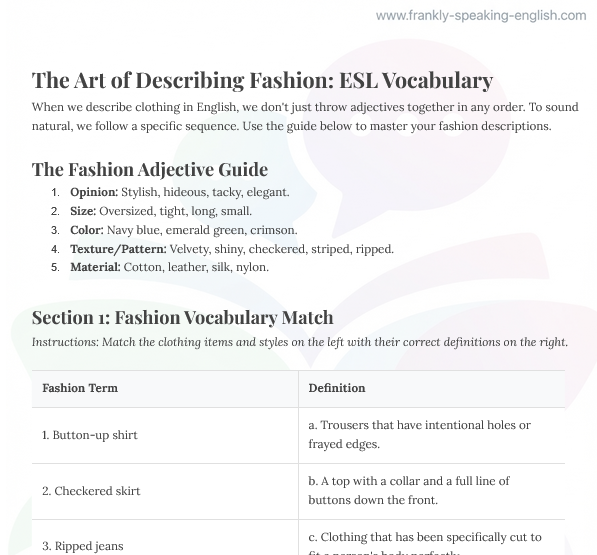
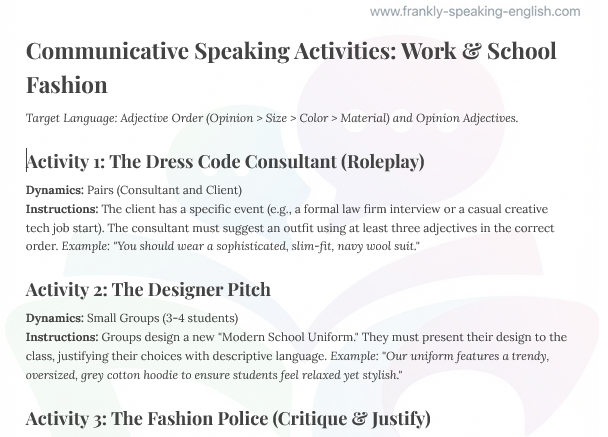
In English, we don’t just throw adjectives together. We follow a specific hierarchy. For fashion, you usually only need these five steps:
- Opinion (How you feel about it): Stylish, comfortable, elegant, trendy.
- Size/Length (How big or long it is): Long-sleeved, oversized, slim-fit, short.
- Color (The hue): Navy blue, charcoal grey, emerald green.
- Material (What it’s made of): Silk, cotton, wool, leather.
- The Noun: Tie, top, blazer, trousers.
If you want to use more adjectives, you may need a more detailed order of adjectives. You can find an example in my previous lesson: Order of Adjectives and Fashion! – Describing clothes – Clothing in English
2. Professional vs. Smart-Casual: Real Examples
Let’s see how this rule works in two different style contexts.
Professional Attire
This is for formal environments. Think of suits, ties, and structured dresses.
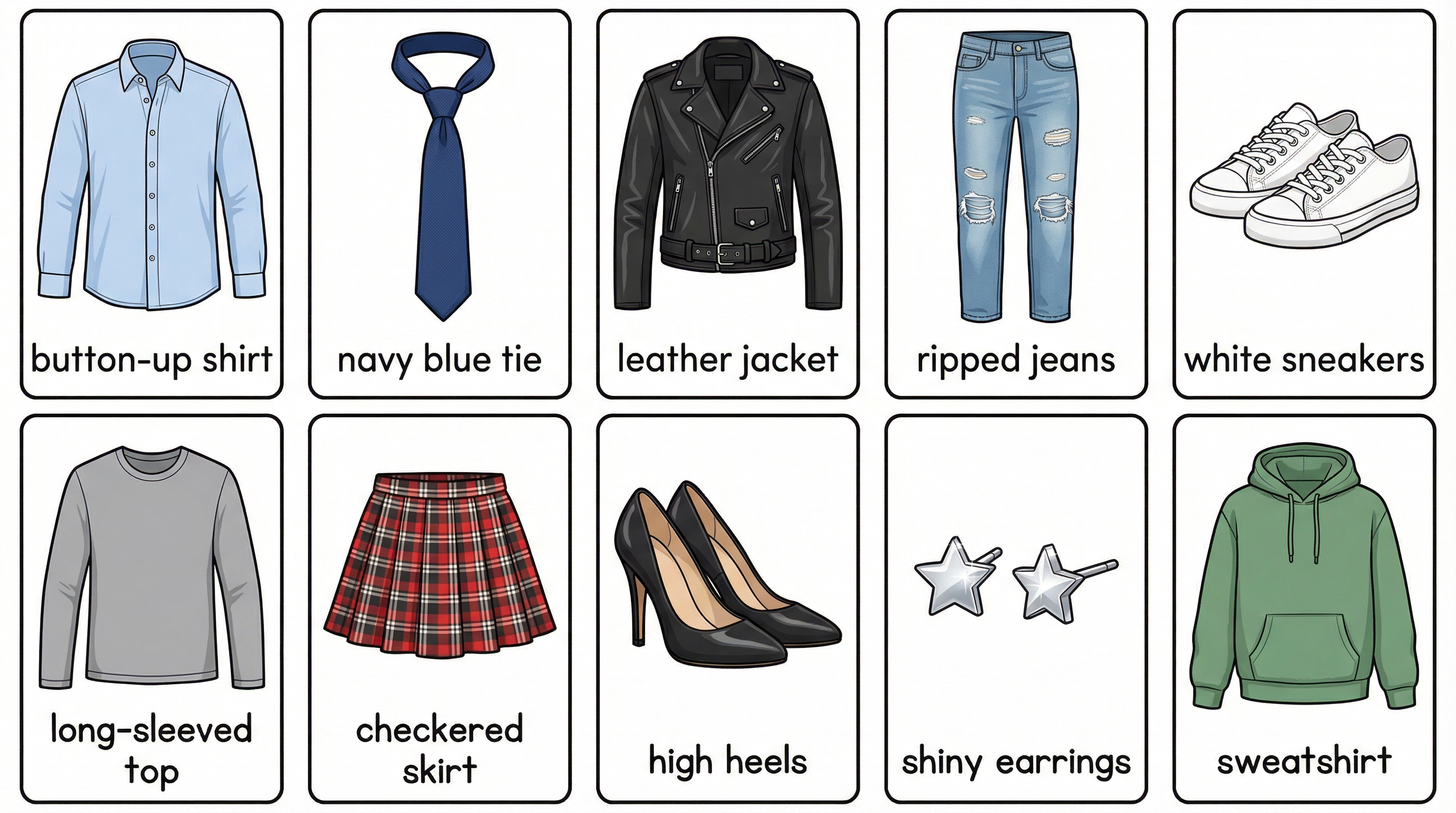
- “He wore a stylish (opinion) navy blue (color) silk (material) tie.”
- “She chose an elegant (opinion) black (color) wool (material) blazer.”
Smart-Casual Attire
This is a mix of professional and relaxed clothing. It’s perfect for many modern offices.
- “I prefer wearing a comfortable (opinion) long-sleeved (length) cotton (material) top.”
- “He paired his jeans with a trendy (opinion) brown (color) leather (material) belt.”
3. Vocabulary Spotlight: The “Polished” Professional
To sound truly intermediate or advanced, you need specific “power words” for fashion. Add these to your vocabulary:
- Tailored: Clothes that are made or altered to fit a specific person perfectly.
- Example: “A tailored charcoal suit makes a great impression.”
- Crisp: Usually describes a shirt that is clean, bright, and perfectly ironed.
- Example: “Nothing looks better than a crisp white cotton shirt.”
- Polished: A way to describe an overall look that is neat, professional, and well-put-together.
- Example: “Her look was very polished and office-ready.”
4. Common Mistakes to Avoid
Even experienced speakers make these mistakes. Keep an eye out for these two:
Mistake 1: Color before Size
In English, we always describe the physical dimensions before the color.
- Wrong: “I am wearing a blue long-sleeved shirt.”
- Right: “I am wearing a long-sleeved blue shirt.”
Mistake 2: Material before Color
The color always comes first. The material is the very last thing you mention before the noun.
- Wrong: “Check out my leather black boots.”
- Right: “Check out my black leather boots.”
Putting It All Together
Describing your style is about more than just the items; it’s about the details. Try to use at least two adjectives the next time you describe what you’re wearing.
Your Turn: Look at what you have on right now. Can you describe one item using the “Adjective Ladder”?
- Example: “I am wearing a comfortable grey cotton hoodie.”
Write your description in the comments below—I’d love to see your “polished” English in action!

Leave a Reply