
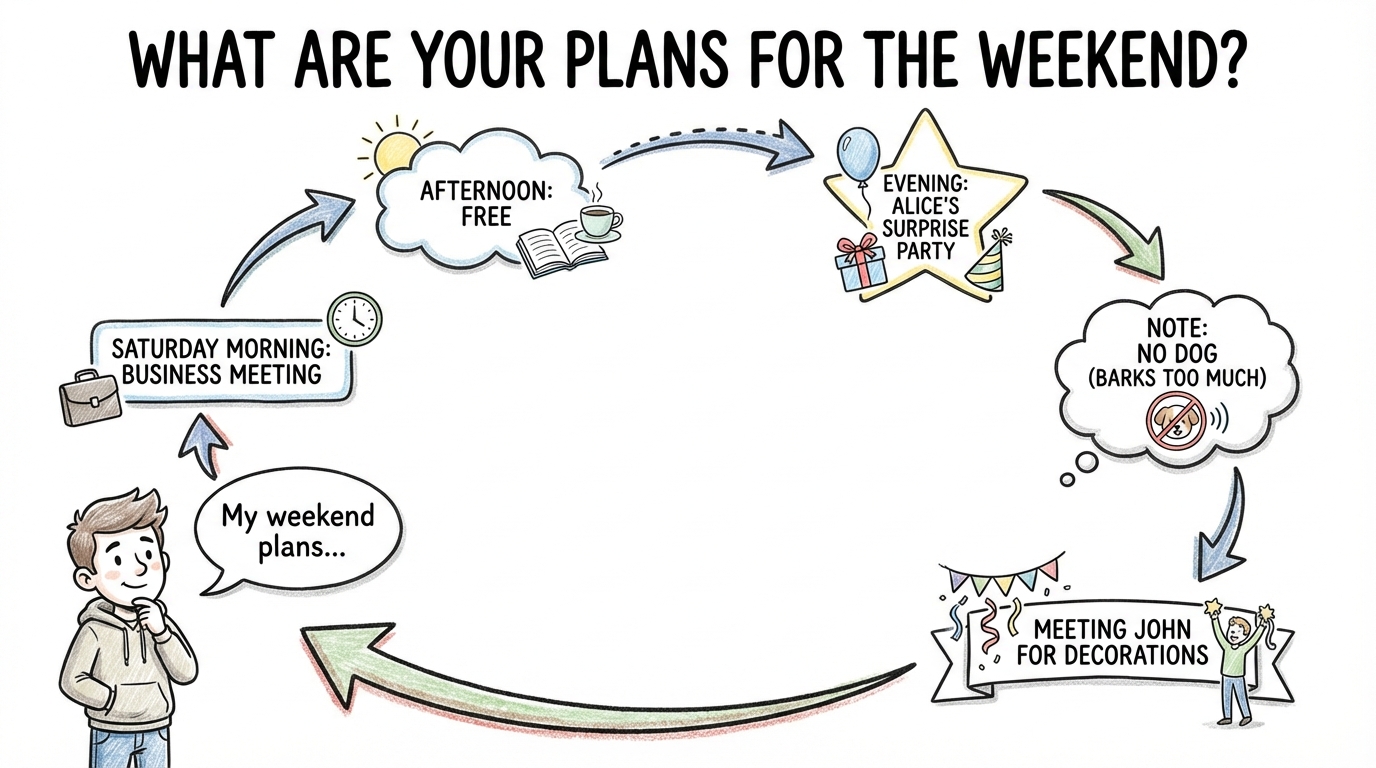
Do you have big plans for the weekend? Maybe you have a date, a flight to catch, or a coffee meeting with a friend. In English, we often use the Present Continuous to talk about these moments.
Wait—isn’t the Present Continuous for things happening right now?
Yes! But it has a secret second job. It is the perfect tense for talking about future arrangements. These are plans you have already organized with another person or written in your calendar.
1. How to Build the Sentence
The formula is exactly the same as the “now” version. You just need to add a time word (like tomorrow, tonight, or at 6:00) so people know you are talking about the future.
The Formula:
Subject + Verb “to be” + [Verb]ing + Future Time
| Subject | Verb “to be” | [Verb]ing | Future Time |
|---|---|---|---|
| I | am (‘m) | meeting | Pete at 6:00. |
| You | are (‘re) | going | to the gym tonight. |
| He / She | is (‘s) | flying | to Paris tomorrow. |
| We | are (‘re) | having | dinner at 8:00. |
| They | are (‘re) | playing | tennis on Saturday. |
Export to Sheets
2. Why Use This Tense?
We use the Present Continuous when a plan is “fixed.” This means you have a ticket, an appointment, or a promise with a friend. It’s not just an idea in your head—it’s actually happening!
- Example: “I’m seeing the doctor on Monday morning.” (I have an appointment).
- Example: “We’re eating at that new Italian restaurant tonight.” (We have a reservation).
3. Common Mistakes to Avoid
When you are learning, these two small errors happen a lot. Keep an eye out for them:
Mistake 1: Forgetting the Verb “to be”
- Wrong: “I meeting Pete at 6:00.”
- Right: “I am meeting Pete at 6:00.”
- Tip: You always need your “partner” (am/is/are) before the -ing.
Mistake 2: Forgetting the “-ing”
- Wrong: “I am meet Pete at 6:00.”
- Right: “I am meeting Pete at 6:00.”
4. Practical Practice
Try using these sentences today to talk about your life:
- “I’m working until 5:00 PM today.”
- “I’m watching a movie tonight.”
- “I’m meeting my family for lunch on Sunday.”
You Can Do It!
The Present Continuous for the future is one of the most common ways native speakers talk. Once you start using it, your English will sound much more natural and organized.
Don’t be afraid to make mistakes—that’s how we learn! Keep practicing, and soon you’ll be talking about your plans with total confidence.

Leave a Reply