
Today, we are looking at the most important “building block” of the English language: Subject Pronouns and the verb “to be.”
Once you master these, you can introduce yourself, talk about your feelings, and describe the world around you. Let’s dive in!
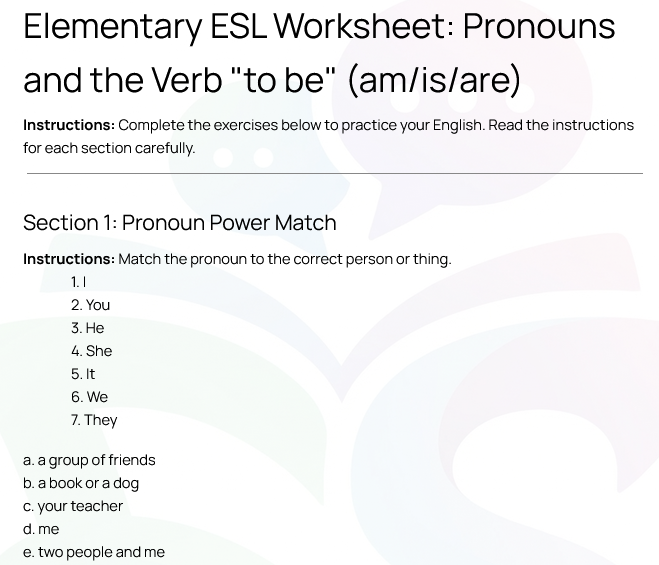
1. The “Who”: Subject Pronouns
Before we use a verb, we need to know who we are talking about. In English, we use these words to represent people or things:
- I (Myself)
- You (The person I am talking to)
- He (A man or boy)
- She (A woman or girl)
- It (A thing or an animal)
- We (Me + other people)
- They (A group of other people)
2. The “Action”: The Verb “To Be”
The verb “to be” is special because it changes depending on the person. In the present tense, there are only three forms: am, is, and are.
Here is how you match them:
| Subject | Verb “To Be” | Example |
| I | am | “I am Frank.” |
| You | are | “You are a student.” |
| He / She / It | is | “He is happy.” |
| We | are | “We are friends.” |
| They | are | “They are in love.” |
3. Putting it into Practice
You can use these sentences to share many different types of information.
Names and Identity
- “I am a teacher.”
- “She is Maria.”
Feelings and States
- “We are hungry.”
- “It is a beautiful day.”
- “They are tired.”
Locations
- “You are at home.”
- “He is in the kitchen.”
4. Watch Out! Common Mistakes
English can be tricky! Even though it feels like “is” or “am” could work for everyone, they have very strict partners. Here are the most common mistakes to avoid:
- Don’t say: “He am Frank.” -> Say: “He is Frank.”
- Don’t say: “They is happy.” -> Say: “They are happy.”
- Don’t say: “I are a student.” -> Say: “I am a student.”
Tip: Think of the subject and the verb like a lock and a key. Only the right “key” (the verb) will open the “lock” (the subject)!
You’re Doing Great!
Learning a new language takes time, but you just learned the most important rule in English. Practice by looking in the mirror and saying three things about yourself: your name, your job, and how you feel.
For example: “I am Frank. I am a teacher. I am happy.”
Your turn! Write a sentence in the comments using “He,” “She,” or “They.” I can’t wait to see your progress!
Looking for more simple lessons? Check out our latest videos on the Frankly Speaking English YouTube channel!

Leave a Reply